

By Liezel Hodgson
22 June 2026
One of the first decisions an entrepreneur must make is whether to operate as a sole proprietor or through a company. Both structures have advantages and disadvantages, and the most suitable option depends on the nature, size, and growth plans of the business.
For entrepreneurs expecting annual turnover below R2.3 million, trading as a sole proprietor may be a simpler and more cost-effective option. Without VAT registration, record-keeping requirements are generally less onerous, and the need for sophisticated accounting systems may be reduced.
Liability remains an important consideration. A sole proprietor and the business are legally the same person, meaning the owner is personally liable for the debts and obligations of the business. Where there is significant risk of legal claims or financial exposure, the protection offered by a company structure may justify the additional compliance requirements.
Tax should also be considered. Companies pay income tax at 27%, but where profits are distributed as dividends, the combined tax burden can increase significantly to 41.6%. If the business falls within the requirements for Small Business Corporation (SBC) the tax rates are significantly reduced, but declaring dividends would also increase the effective rate.
Individuals, on the other hand, are taxed according to SARS’s progressive tax tables. For example, a taxpayer with taxable income of R800,000 in the 2027 tax year would currently pay tax of approximately R214,768 after primary rebate, representing an effective rate of approximately 26.85%, before considering any additional deductions, exemptions, or tax relief available to individuals.
The most tax-efficient structure will therefore depend on factors such as profit levels, whether profits will be retained in the business, and the owner’s personal tax position.
Businesses employing staff must register for Employees’ Tax (PAYE) regardless of whether they operate as a sole proprietor or company. If you would be the company’s only employee, then trading as a Sole proprietor would further reduce the administrative burden.
The long-term plans for the business are equally important. Entrepreneurs intending to attract investors, introduce partners, or build a business that can operate independently of the owner may find a company structure more suitable.
Companies also have additional compliance requirements, including annual returns to CIPC, annual financial statements, and other statutory reporting obligations. These costs should be weighed against the potential benefits of limited liability and favourable tax treatment.
There is no single correct answer. The most appropriate structure depends on the business’s expected profitability, risk profile, growth ambitions, and administrative capacity. Obtaining professional advice before deciding can help ensure that the chosen structure supports both the entrepreneur’s current needs and long-term objectives.
| Consideration | Sole Proprietor | Company |
| Set-up and administration | Simple and inexpensive | More formal with ongoing compliance requirements |
| Personal liability | Owner is personally liable for business debts | Legal separation between owner and business |
| Income tax | Taxed at individual tax rates | Taxed at company tax rates |
| SBC tax benefits | Not available | May qualify for favourable SBC rates |
| Dividends tax | Not applicable | May apply when profits are distributed |
| VAT registration | Same VAT rules apply | Same VAT rules apply |
| Employees | Must register for PAYE if required | Must register for PAYE if required |
| Bringing in investors | Difficult | Easier through shareholding |
| Business succession | Linked to the owner | Easier to transfer ownership |
| Compliance requirements | Relatively low | Annual CIPC, financial statements and other statutory requirements |
| Best suited for | Small owner-managed businesses with lower risk | Businesses with growth plans, investors, or higher liability exposure |
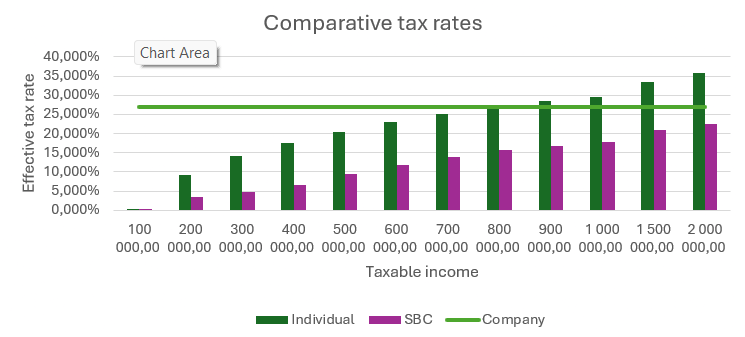
This graph is based on tax rates applicable to 2027 tax year – the primary rebate for individuals is deducted. The graph compares effective tax rates if profits are retained in the company. Where profits are distributed to shareholders, dividends tax may apply and should be considered when comparing the overall tax burden to that of an individual sole proprietor.
Contact our team to discuss how we can help structure your business in a way that supports your current needs and future growth plans.
www.auroprofessional.com
Paarl | Stellenbosch | Franschhoek | Wellington | Somerset West | Durbanville | Cape Town | Western Cape